Finding Your Tennessee Hardiness Zone by Local ZIP Code
A ZIP code can point you toward a Tennessee hardiness zone, but it cannot tell you everything about the growing conditions in your yard. Use the zone as a first screen for perennial plants, then account for elevation, exposure, and local frost timing before choosing what to plant. Here’s how to look up the zone and use it without treating it as a planting calendar.
What a Tennessee hardiness zone tells you
The USDA Plant Hardiness Zone Map is a tool for estimating whether a perennial plant is likely to survive winter in a particular area. Its zones are based on the average annual extreme minimum winter temperature: in other words, the average of the lowest temperatures recorded each year over a period of time. The map divides those averages into bands, with smaller subdivisions showing warmer or cooler parts of a band.
The word average matters. A zone is not a promise that a yard will never experience colder weather. It is a way to compare the winter cold a plant can generally tolerate with the winter cold typical of a location. A plant described as hardy in a particular zone may be a reasonable candidate where the map indicates similar winter conditions, but its survival can still depend on exposure, drainage, snow cover, age, and care.
Hardiness is most useful when choosing plants that are expected to live through winter outdoors, such as many perennial flowers, shrubs, and trees. It is less useful for deciding when to sow vegetables, set out tender annuals, or expect the last spring frost. Those decisions depend on seasonal weather, soil conditions, and the plant’s temperature needs—not just the coldest part of winter.
| Question | Is a hardiness zone the right tool? | What else to consider |
|---|---|---|
| Is a perennial likely to survive typical winter cold? | Yes, as an initial screen | Drainage, wind exposure, plant establishment, and unusually cold winters |
| When can tender vegetables go outdoors? | No, not by itself | Spring frost risk, soil warmth, and crop sensitivity |
| Will a plant tolerate Tennessee summer heat? | Not reliably | Heat tolerance, sun exposure, moisture, and air circulation |
| Will a plant thrive in a wet or shaded bed? | No | Soil drainage, hours of sunlight, and local site conditions |
| When should fall crops be planted? | No, not by itself | Expected fall freezes, crop maturity time, and local weather |
A zone is therefore a useful clue, not a complete description of a place. It does not measure summer heat, rainfall, humidity, wind, soil type, drainage, or the length of the frost-free season. Two gardens that fall in the same zone can still have very different growing conditions.
It also does not tell you what will happen in a specific winter. A plant that has survived several winters may be injured by an unusually severe cold event. Conversely, a plant near the edge of its listed hardiness may survive when it is planted in a sheltered spot with well-drained soil. The zone helps frame the risk; it does not remove it.
For a broader view of regional patterns, Tennessee Growing Zones Map: Central and Western Regions can help put a ZIP-code result in context. The key is to use the map as a starting point, then check the conditions of the actual planting site.
How to look up a zone using your ZIP code
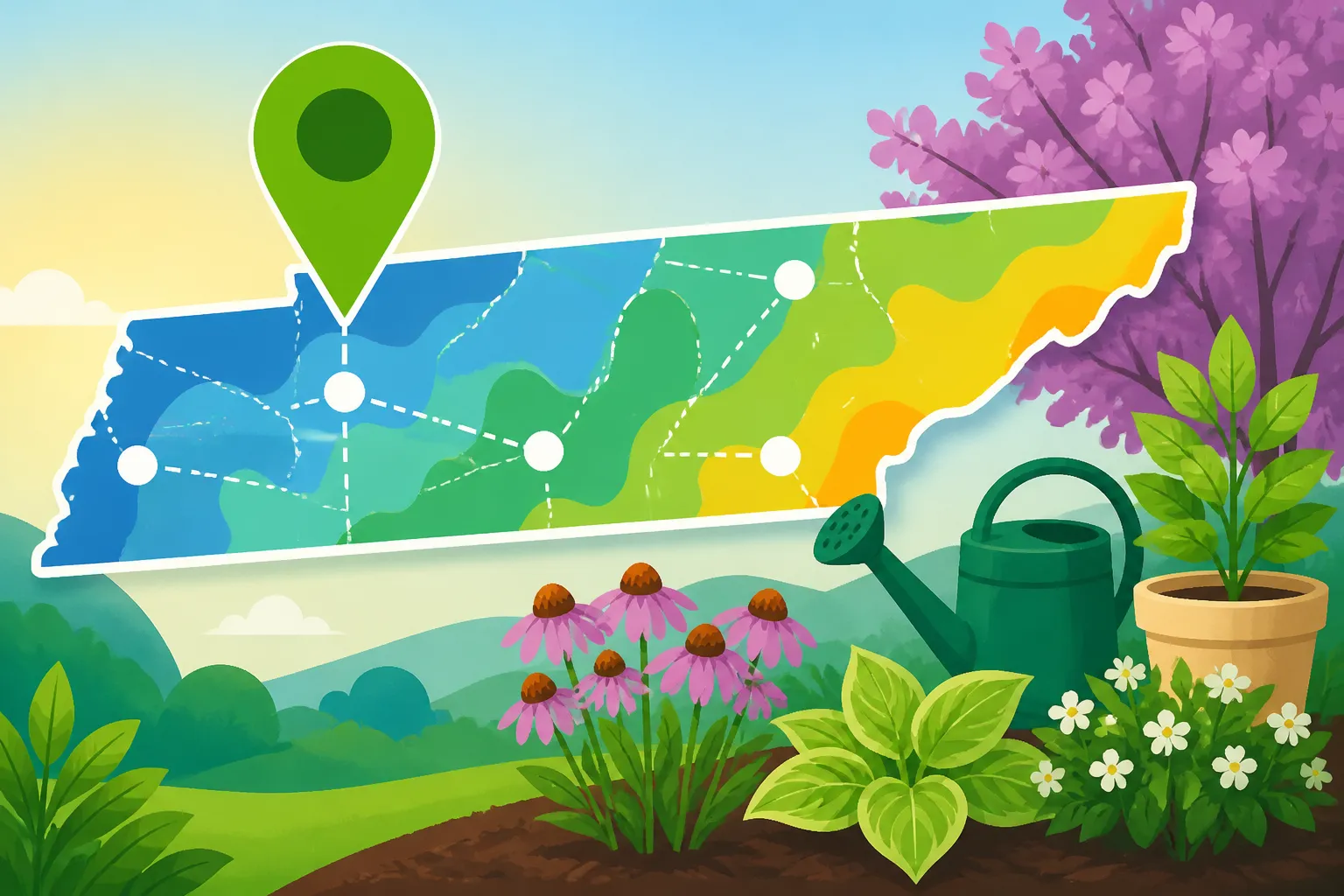
The USDA Plant Hardiness Zone Map includes a location search that can help you find the map area associated with a ZIP code. Use the official map to check the result, rather than relying only on a nursery tag, a general gardening article, or a search result that may use a different map edition.
Start with your ZIP code
Enter the ZIP code for the place where you plan to garden. Treat the result as a broad locator rather than a precise reading for every property within that postal area. A ZIP code may cover a wide area, and the map’s colors can change across hills, valleys, or urban and rural surroundings.
If you are checking a place you do not live in, make sure you use the ZIP code for the garden’s location, not the one associated with a mailing address or a business elsewhere. For a large property, a single ZIP-code lookup still cannot account for all the differences between exposed ridges, low ground, and sheltered areas.
Inspect the map around the location
After getting a result, zoom in and look at the surrounding map. Check whether the location sits near a change in color or a boundary between zones. If it does, the ZIP-code label may not describe every part of the area equally well. A location close to a boundary deserves more caution than one well inside a broad, consistent region.
Do not assume that a boundary follows a county line, city limit, highway, or other feature that is easy to recognize. Map boundaries reflect climatic patterns, not the lines people use for property, postal, or administrative purposes. Use the map’s displayed location and scale rather than trying to infer a zone from a nearby town name.
If the map allows you to move or zoom the view, compare the searched point with the immediate surrounding landscape. That will not reveal the exact temperature history of your backyard, but it can show whether the area appears climatically uniform or close to a transition.
Record what the map actually reports
Write down the map result and the map source you used. If a plant label or online listing gives a hardiness range, compare it with the result from the same map system where possible. Different sources may use older maps or general regional estimates, so apparent conflicts do not always mean a plant seller or map is necessarily wrong.
If several sources disagree, do not choose the warmest result just because it allows more plant options. Check the official map, note whether the location is close to a boundary, and consider the consequences if the plant is damaged in a cold winter. For a valuable tree or shrub, a conservative choice is often less costly than gambling on a borderline fit.
Interpret the result as a local estimate
A ZIP-code search gives you a useful regional reference. It does not measure the temperature beside your house, within a garden bed, or at the bottom of a slope. If your property has substantial changes in elevation or exposure, different planting spots may behave differently even though they share the same postal code.
For another look at how to combine a map result with local conditions, see Looking Up Your Tennessee Planting Zone and Microclimate. The practical goal is not to force a single number onto every corner of a yard. It is to understand the general winter risk and then decide whether a particular planting site is warmer, colder, wetter, windier, or more exposed than its surroundings.
Why one ZIP code does not describe every Tennessee yard
Tennessee has varied terrain and local weather patterns. A ZIP-code lookup is useful, but the conditions within one postal area can differ enough to matter to plants. In particular, elevation, slope position, nearby buildings, and exposure can influence how a garden experiences cold.
Elevation and terrain
Higher or more exposed locations can experience colder conditions than sheltered lower ground nearby. In valleys and other low areas, cold air may settle on clear, still nights. A home on a slope may have different cold exposure from a home in a low spot, even when the two are close together.
These patterns do not mean every hilltop is colder or every valley is warmer in every weather situation. They are reasons to observe the site rather than assume the map applies uniformly. Across Tennessee, terrain can shift over short distances, so a regional result may not capture the specific conditions of a hillside garden or a low-lying bed.
If you are gardening at higher elevation, a calendar built for a lower, warmer location may not fit your season. High-Elevation Planting Calendars: Adjusting for Cooler Nights offers a more focused look at that issue. For mountain and valley settings, Mountain Valley Planting Schedules: Spring to Autumn Timelines can also help explain why nearby gardens may need different schedules.
Buildings, pavement, and sheltered corners
Walls, fences, large trees, and other structures can change a plant’s exposure to wind and cold. A sheltered position beside a building may be less exposed than an open bed. Pavement and building materials can also affect the temperature around a planting area, though those effects vary with the site and weather.
A warm pocket does not turn a tender plant into a reliably hardy one. It may reduce exposure to some cold conditions, but a severe freeze can still injure plants in sheltered spots. A spot close to a heated building may also receive uneven protection, while the same plant a short distance away remains exposed.
When evaluating a candidate location, consider the whole setting: whether cold air can drain away, whether wind hits the site directly, whether the ground stays wet, and whether nearby structures provide shade or shelter. These details can matter as much as the ZIP-code result when you are deciding where to plant a borderline perennial.
Sun, moisture, and drainage
Hardiness zones do not tell you whether a plant will cope with full sun, afternoon heat, dry soil, or persistent moisture. A plant may survive winter and still decline because its location is too hot, too wet, too dry, or too shaded.
Wet soil is a particular concern for many plants during cold weather. A plant suited to a zone may still struggle if its roots sit in poorly drained ground. Likewise, a sunny, sheltered bed might warm up sooner in spring but become stressful during hot weather. Choosing a plant based only on its winter rating ignores much of what determines its performance.
Before planting trees, shrubs, or perennials, check the site’s sun and drainage as well as its cold exposure. If you are selecting plants for a particular bed, Fitting a Vegetable Garden to Your Yard’s Real Soil discusses why soil and site conditions deserve attention alongside broad climate information. For landscape plantings, the same principle applies: match the plant to the actual place, not just the map label.
How to use the zone when choosing plants
Once you have a ZIP-code result, use it to screen plant choices rather than make the decision on its own. Check the hardiness information provided for the plant, but also examine what the plant needs in terms of sun, soil, moisture, and seasonal heat.
Compare the plant’s winter tolerance with the map result
If a plant’s listed winter tolerance appears to fit the map result for your area, that is a reason to consider it, not a guarantee of success. Look for other requirements that might rule it out: soil that drains quickly, protection from strong wind, a particular amount of sunlight, or a cooler summer environment.
When a plant is described as suitable only for warmer conditions than your map result suggests, think carefully about the risk. A sheltered position may improve its chances, but it cannot ensure survival through all winters. If the plant is expensive, slow-growing, or difficult to replace, choosing a more cold-tolerant option may be the sensible trade-off.
Plants near the edge of their stated tolerance may need more careful siting than plants comfortably within it. That does not mean you should never try an edge-of-range plant. It means you should treat the planting as higher risk and avoid assuming that a mild winter proves it will always be safe.
Separate winter survival from summer performance
A hardiness rating concerns winter cold. It does not tell you how a plant responds to Tennessee’s summer heat, humidity, or dry spells. A plant may survive the winter but produce poorly, scorch in direct sun, or need more water than the site can provide.
For edible gardens, this distinction matters. Vegetable varieties and planting dates are generally selected around the crop’s preferred growing temperatures and the timing of spring and fall conditions, not its winter-hardiness zone alone. Use Tennessee Home Vegetable Gardening Guide: Soil, Sun, and Care for broader growing considerations, and refer to a regional calendar when planning sowing and transplanting.
A vegetable garden calendar should account for more than the map color. Tennessee Planting Calendars: Adjusting for Region explains why the state’s different growing conditions call for local adjustments. For warm-season crops, When to Plant Warm-Season Vegetables Outdoors is more relevant to the planting decision than a winter-zone lookup.
Use hardiness information for perennials thoughtfully
For perennial flowers, shrubs, and trees, the zone can help narrow a long list of possibilities. After that initial screen, check the plant’s mature size, light requirements, soil preferences, water needs, and likely maintenance. Consider whether the planting site is exposed to winter wind or prone to standing water.
A plant’s hardiness can also depend on whether it is established. A newly planted specimen may be more vulnerable than one with a developed root system. Good planting practices and appropriate care can help a plant establish, but they do not make a poorly matched plant a reliable choice.
The intended use matters, too. A plant that survives but repeatedly suffers winter injury may not be a good fit for a formal border or a screen where consistent appearance is important. For a low-maintenance planting, prioritize a plant suited to both the likely winter conditions and the site’s everyday demands.
Keep a record of what works in your own yard
Over time, garden observations can refine your interpretation of the map. Record where plants are growing, how exposed the location is, and whether they show winter injury or summer stress. A few seasons of notes can reveal patterns such as a consistently cold low bed or a sheltered area that warms early.
Do not treat one successful winter as proof that a borderline plant is completely safe. Weather varies, and a plant may survive several mild winters before experiencing damaging cold. Still, local records can help distinguish a persistently exposed site from a reliable sheltered corner and support better choices for future plantings.
Why a hardiness zone is not a planting calendar
A common mistake is to use the hardiness zone as if it were a schedule for putting seeds or transplants in the ground. The map is not designed to tell you when spring has arrived, when a late frost is likely, or when soil is warm enough for a particular crop.
Spring planting depends on frost risk and crop sensitivity
Tender vegetables and annual flowers can be damaged by frost or cold conditions even in places where perennial plants are well suited to the winter zone. Their outdoor timing depends on the crop and on local spring weather. The zone does not show the date of the last spring frost, nor does it predict a particular year’s weather.
A nearby garden may be ready for one crop while another site is still exposed to cold nights. Gardeners should consider local frost patterns and the needs of the plant being set out. For regional context, see Tennessee Frost Dates: Spring and Fall Freeze Timelines. Frost dates are estimates based on records, not fixed annual deadlines, so checking the forecast near planting time remains important.
Soil temperature and soil condition can matter as well. A bed that is cold and wet may not be suitable for a crop simply because the hardiness map looks favorable. The planting decision should combine the crop’s temperature needs, the local forecast, and the condition of the garden soil.
Fall timing is different from winter hardiness
Fall crops need enough time to develop before cold weather slows growth or a freeze damages them. A winter zone does not tell you how much growing time remains, when a particular bed will receive its first damaging freeze, or how quickly a crop can mature under shortening days.
For fall planting, work backward from a realistic local freeze period and the crop’s expected time to maturity. Consider that garden conditions may differ from the weather station or regional estimate used for a calendar. A shaded site or high-elevation garden may lose growing time sooner than a sunny, sheltered one.
The practical answer is to use the zone for perennial winter survival and a regional calendar for seasonal planting. Then make adjustments based on your own garden and the weather. The two tools answer different questions, and neither replaces the other.
Heat, humidity, and rainfall are separate concerns
A zone result should not be read as a rating for summer performance. It does not describe how long a heat wave may last, how humid the air may be, or whether rainfall will meet a plant’s needs. A plant may tolerate winter cold but struggle during hot, dry weather.
That is one reason plant descriptions should be read as a whole. Check for notes about heat tolerance, moisture, shade, and soil conditions. If the plant is intended for a vegetable bed, also consider the season when it produces best. Winter survival and productive growth are not the same measure.
Common mistakes when checking a ZIP-code zone
A quick lookup is easy, but a few common assumptions can lead to poor plant choices. Avoiding them makes the map more useful and reduces the chance of treating a broad estimate as a guarantee.
Treating a ZIP code as a property-level reading
A postal area is not a weather station. It can include several different landscapes and planting environments. If a map result sits near a zone boundary, do not assume every yard in the ZIP code falls on the same side of that boundary.
Check the map at a useful scale, look at the surrounding pattern, and account for your site. For property-specific decisions, compare the map with your own observations of cold exposure, terrain, and shelter. How Tennessee Hardiness Zones Vary Across Town Borders is useful context for understanding why a zone result may change across nearby locations.
Assuming every plant label uses the same map
Plant tags, catalogs, and web pages may not all use the same source or map edition. Some descriptions may also be broad regional guidance rather than a precise local recommendation. If a label seems inconsistent with the official map, confirm the map result and read the full plant description instead of relying on a single number.
Where practical, seek information that names the plant’s winter tolerance and explains any site requirements. A label that gives only a zone range may not tell you whether the plant needs excellent drainage, winter shelter, or protection from hot afternoon sun.
Confusing hardiness with frost-free timing
The hardiness map focuses on winter minimum temperatures. It does not show when your garden will be free of frost in spring or when the first fall freeze will arrive. Treating it as a date calendar can put tender plants at risk.
Use frost information and local forecasts for timing sensitive crops and annuals. For vegetables, the relevant planting schedule will vary by crop, region, and weather. The map can add background context, but it should not be the deciding factor for setting out tomatoes, peppers, or other tender plants.
Overlooking the planting spot
A plant can fail because its location is wrong even when its winter rating appears suitable. Poor drainage, dense shade, reflected heat, strong wind, or lack of water can outweigh a reasonable zone match. Before buying, ask whether the plant’s requirements match the bed where it will actually grow.
A good practice is to compare the plant’s needs with the site before deciding whether the plant is appropriate. If the bed does not fit, look for a better location or a different plant rather than expecting a zone label to overcome the mismatch.
Treating a favorable result as a guarantee
A map result summarizes typical conditions; it does not prevent unusually cold weather. Risk is higher when a plant is at the edge of its stated tolerance or when it is newly planted, exposed, or growing in wet soil. Decide whether that risk is acceptable for the plant’s cost and purpose.
For a specimen that would be difficult to replace, choose a more resilient option or a better-protected planting site. For an experimental planting, accept that the result may vary and avoid making the entire garden depend on one borderline choice.
A practical checklist for using your Tennessee result
Before purchasing or planting, use this short process to connect the map result to the garden decision:
- Look up the location on the official USDA Plant Hardiness Zone Map. Use the ZIP code to find the area, then inspect the map around the location.
- Check whether the site is near a map boundary. If it is, be cautious about treating the ZIP-code result as exact for every yard.
- Identify the plant’s winter tolerance. Compare it with the map result, but remember that a listed rating is not a guarantee.
- Check the plant’s other requirements. Review its needs for sunlight, soil drainage, moisture, and summer conditions.
- Consider the exact planting spot. Note elevation, slope, wind, nearby structures, and whether cold air or water collects there.
- Use a planting calendar for seasonal timing. For seeds, transplants, and fall crops, check regional frost and crop-timing guidance rather than relying on the zone.
- Keep notes. Track where plants are placed and how they respond over multiple seasons. Treat observations as useful local evidence, not as proof that extreme weather cannot cause damage.
This approach makes a ZIP-code lookup more useful without asking it to answer questions it was not designed to answer. The map gives a general reference for winter cold. Your site observations and planting calendar fill in the rest.
Frequently Asked Questions
Can I find my exact Tennessee hardiness zone from a ZIP code?
A ZIP code can help locate an area on the USDA map, but it does not provide an exact reading for every property within that ZIP code. Terrain, elevation, exposure, and map boundaries can make nearby sites differ. Use the map result as a starting point and inspect the local pattern.
Does my hardiness zone tell me when to plant vegetables?
No. The zone is designed to describe typical winter cold, not spring frost dates, soil warmth, or crop-specific planting windows. Use a regional vegetable calendar and local weather information to time sowing and transplanting.
Can a sheltered yard support a plant outside its listed hardiness?
Shelter may reduce exposure to wind or some cold conditions, but it cannot guarantee survival through an unusually severe winter. A borderline plant may still be injured, especially in an exposed or poorly drained spot. Consider how much risk is acceptable before planting.
Why do nearby Tennessee locations show different zones?
Hardiness zones reflect differences in winter minimum temperatures. Elevation, terrain, and local exposure can change those conditions across short distances. A ZIP-code result can therefore differ from a nearby location, particularly around a map boundary.
If a plant survives one winter, is it a safe choice?
Not necessarily. A mild winter may not test the plant’s full cold tolerance. Several seasons of observations can help you assess your site, but unusual weather can still cause damage. For plants that need to be reliable, choose a suitable location and avoid depending on a borderline match.
Disclaimer
This article is for general informational purposes only and does not constitute professional advice. Laws, prices and regulations vary by location and change over time. Consult a qualified professional for guidance on your specific situation. Tennessee Gardening Guide is not a government agency and is not affiliated with any university extension, state department of agriculture or other government agency.